
If there’s one kitchen question most people ask all the time, it’s this: how many ounces are in a cup? In this guide, I will break it down clearly so you never second-guess your measurements again.
How many ounces are in a cup? The Short Answer
Here’s the simple version I always keep in mind:
- 1 cup (liquid) = 8 fluid ounces
- 1 cup (dry ingredients) ≠ always 8 ounces (by weight)
I’ve tested several conversions countless times in my kitchen, especially when developing recipes. Getting measurements right is one of the easiest ways to improve your cooking results, and once you understand how ounces and cups relate, everything becomes much simpler.
How Many Ounces in a Cup?
Well, the answer can be complicated, as not all measurements are created equal. The simple answer is, it depends on what you are measuring. For liquid ingredients, the conversion is straightforward, but for dry ingredients, things become a little trickier.
Fluid Ounces vs Dry Ounces
Fluid ounces measure volume. How much space a liquid takes up.
- 1 cup = 8 fluid ounces
- Used for liquids like water, milk, oil, or broth
Liquids are consistent in volume measurement, but not in weight. Here's a practical breakdown.
Liquid Ingredients
| Liquid | 1 Cup Equals |
|---|---|
| Water | 8 fl oz |
| Milk | 8 fl oz |
| Oil | 8 fl oz |
| Honey | 8 fl oz |
Note that: Liquids are measured in fluid ounces, which measure volume, not weight. One cup always equals 8 fluid ounces, regardless of the liquid, but the weight can vary depending on density.
For example:
- 1 cup water ≈ 8 oz (weight)
- 1 cup oil ≈ 7 oz (weight)
- 1 cup honey ≈ 12 oz (weight)
Dry Ounces (Weight) - Why 1 Cup Is Not Always 8 Ounces
Converting dry ingredients is a little more complicated. When recipe writers such as myself measure out dry ingredients in cups, we are talking more about volume than weight. The actual weight will depend on the density of the ingredient you are measuring.
For example, 1 cup of fresh spinach weighs about 1 ounce. Whereas a cup of chocolate chips, which are denser, will weigh approximately 6 ounces.
Dry ounces measure weight, not volume.
That means:
- 1 cup of flour is not equal to 8 ounces
- 1 cup of sugar is not equal to 8 ounces
1 cup always equals 8 fluid ounces (volume). But it does not always equal 8 ounces by weight. Each ingredient weighs differently. Here’s a practical breakdown:
Dry Ingredients
| Ingredient | 1 Cup Equals |
|---|---|
| All-purpose flour | ~4.25 oz |
| Granulated sugar | ~7 oz |
| Brown sugar (packed) | ~7.5 oz |
| Butter | 8 oz |
| Chocolate chips | ~6 oz |
These differences happen because ingredients have different densities.
An Ounce vs. A cup
Most commonly used in the U.S. and the United Kingdom, an ounce is a unit of measurement for weight. An ounce weighs roughly 28.53 grams. It is a small unit of weight. On the other hand, a cup primarily measures volume.
How This Connects to Other Kitchen Conversions
Understanding ounces and cups is just one part of the bigger picture.
If you cook regularly, you will need these:
- A full liquid conversion chart for precise measurements
- My guide on how many teaspoons are in a tablespoon for quick substitutions
- A breakdown of how many grams are in an ounce when working with weight
And if you are a regular baker, don’t forget to check out the oven temperature conversion guide. It comes in handy when using international recipes.
All of these together make cooking much easier.
Liquid ingredients
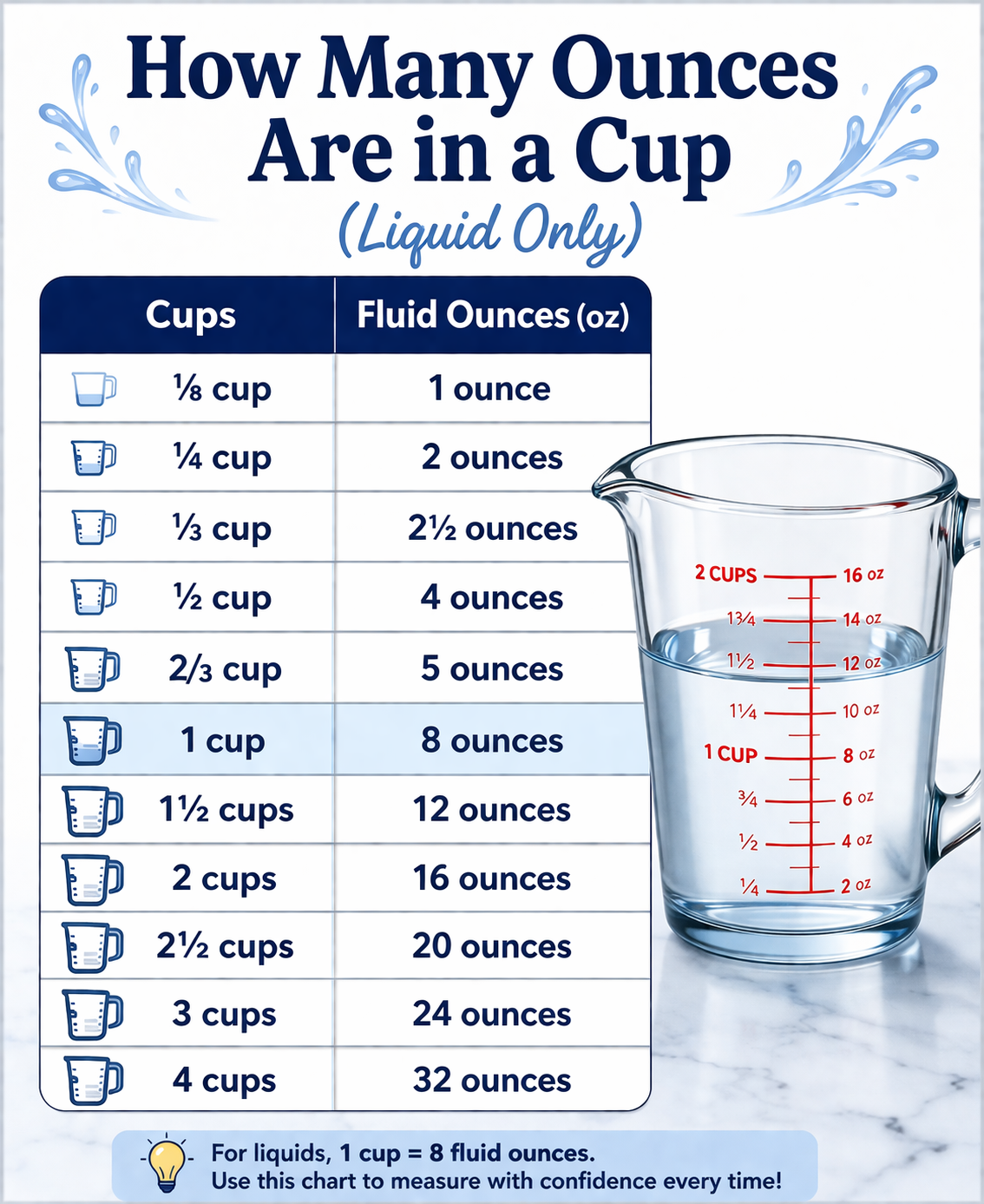
With liquids, the answer is simple and easy to remember. Liquids are measured in fluid ounces, and there are 8 fluid ounces in 1 cup. This is true of all liquids.
| Cups | Fluid Ounces (oz) |
|---|---|
| ⅛ cup | 1 ounce |
| ¼ cup | 2 ounces |
| ⅓ cup | 2½ ounces |
| ½ cup | 4 ounces |
| ⅔ cup | 5 ounces |
| 1 cup | 8 ounces |
| 1½ cups | 12 ounces |
| 2 cups | 16 ounces |
| 2½ cups | 20 ounces |
| 3 cups | 24 ounces |
| 4 cups | 32 ounces |
What is the difference between Ounces (oz.) and Fluid Ounces (Fl. oz.)?: Wet vs. Dry Ingredients
When calculating ounces, many people confuse liquids with solids. Ounces are generally divided into dry ounces and fluid ounces.
The simple difference is that an ounce measures dry ingredients, while a fluid ounce measures liquid ingredients. Also, ounces measure the weight of dry ingredients, while fluid ounces measure the volume of liquids.
For dry ingredients, use ounces; for liquids, use fluid ounces. For dry ingredients, you need a scale; for wet ingredients, you need a wet measuring cup. Examples of dry ingredients include salt, flour, baking soda, cocoa powder, baking powder, sugar, and powdered milk. Wet ingredients include water, oil, eggs, milk, yogurt, and honey.
Different Measurement Systems for a Cup
The measurement system for cups in the US is different from the system in the UK. For example, while a cup is 8 ounces in the US, a cup is 10 ounces in the UK, Australia, and Canada.
For dry measurements, the simple formula is: 1 ounce = ⅛ cup. For wet measurements in the US, 8 Fluid Ounces = 1 Cup. Whereas in the UK, it is 10 Fluid Ounces = 1 Cup
How to fill in a dry measuring cup
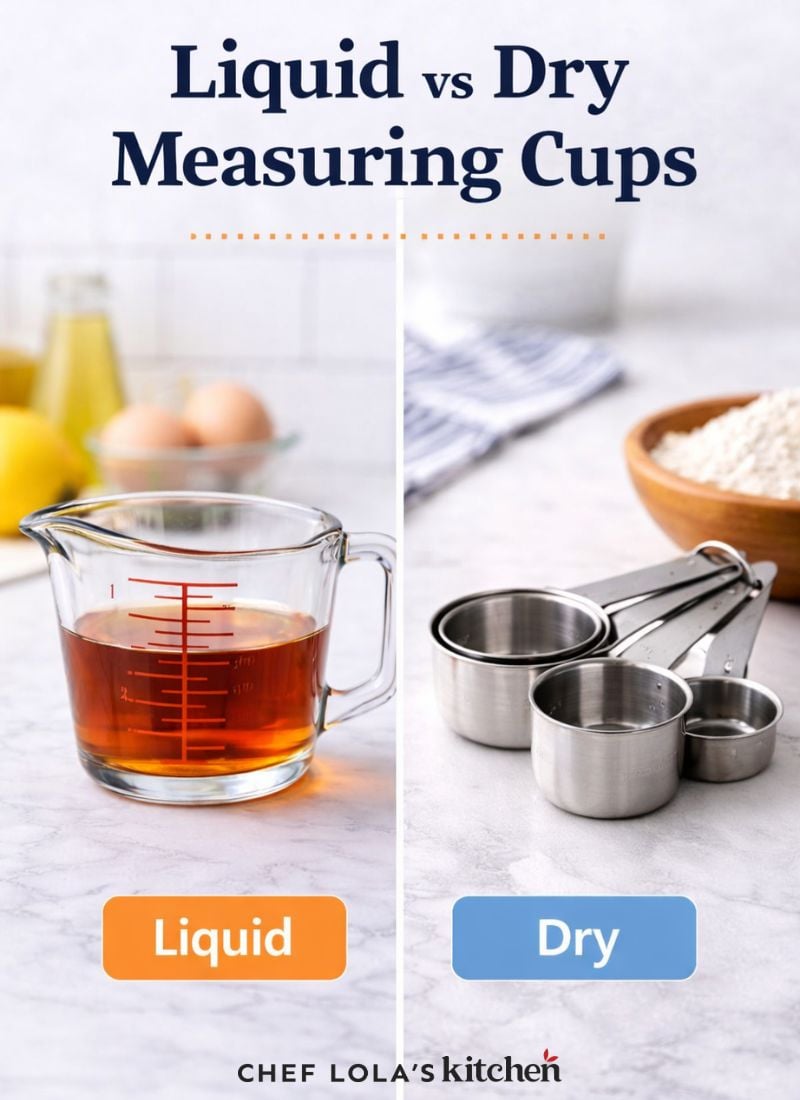
A liquid measuring cup can be made of plastic or glass and has measurement lines on the side. On the contrary, a dry measuring cup is designed to hold a specific amount of dry ingredients. So, you have to level the ingredients with a butter knife once you fill it. To fill your dry measuring cups, you can do the following:
- Step 1 - To use the dry measuring cup, first put your measuring cup in a bowl.
- Step 2 - Pour the dry ingredients gently into the cup.
- Step 3 - When it is full to the brim, you can level it and remove the excess into the bowl.
- Step 4 – You can check the measuring rule on the cup or place it on the scale to weigh.
How to fill in a Wet Measuring Cup
It is easier to fill the liquid measuring cup than a dry one. Cups come with a pouring edge to aid in transferring liquid from the storage container to the cup. The pouring edge prevents the liquid from spilling.
- Step 1: Pour the liquid into the measuring cup gently
- Step 2: Check the measuring line on the side to track the measurement.
- Step 3: If you need to weigh it, you can use your scale.
How many ounces are in a Cup of water?
- ¼ cup = 2 oz
- ⅓ cup = 2 ½ oz
- ½ cup = 4 oz
- 1 cup = 8 oz
How Many Ounces in A Cup of Maple Syrup?
- ¼ cup = 3 oz
- ⅓ cup = 4 oz
- ½ cup = 6 oz
- 1 cup = 12 oz
How Many Ounces in a Cup of Cocoa Powder?
- ¼ cup = 0.9 oz
- ⅓ cup = 1.2 oz
- ½ cup = 1.3 oz
- 1 cup = 3 ½ oz
How Many Ounces in A Cup of Flour?
- ¼ cup = 1 oz
- ⅓ cup = 1 ½ oz
- ½ cup = 2 ¼ oz
- 1 cup = 4 ½ oz
Should I use measuring cups or scales?
Liquid ingredients can be measured just as accurately in cups as on a measuring scale. Now that you know the handy conversion, you can switch between the two as you wish.
If a recipe calls for measuring a dry ingredient in cups, go ahead and do it. The recipe writer will have taken into account the volume of the ingredients and figured out the correct amount for you. However, pay close attention to how the recipe says you should prepare the ingredient. A cup of finely chopped spinach will weigh a little more than a cup of loosely packed spinach. Equally, a cup of grated cheese will weigh more than a cup of chunks of cheese, as you can pack more of it in.
If the recipe lists dry ingredient measurements in ounces, it is always more accurate to use a scale than to convert them to cups.
If you don’t have a kitchen scale, the blog King Arthur Baking has a detailed table.
It shows how much one cup of dry ingredients weighs, in ounces and grams.
FAQs
Is 1 cup always 8 ounces?
Only for liquids. Dry ingredients vary by weight.
Should I use cups or ounces?
I use cups for everyday cooking and ounces (weight) for baking precision.
What’s the difference between fl oz and oz?
- fl oz (fluid ounces) = volume
- oz (ounces) = weight
Understanding this difference is key to accurate cooking.
Check other similar measurement posts you might be interested in:
- Liquid measurement conversion chart
- How many teaspoons in a tablespoon?
- Oven temperature conversion
- How Many Grams in an Ounce
Let’s connect on YouTube, Facebook, and Instagram. I love keeping in touch with you, and nothing brings me more joy than seeing pictures of your creations. Tag me @cheflolaskitchen on Instagram and Facebook.


Jill
Friday 6th of October 2023
But the last three conversions on the top chart is wrong! You have three (same) cup measurements "equaling" different amounts of ounces.
Chef Lola's Kitchen
Saturday 25th of May 2024
Thank you. Its been corrected.
Dana
Tuesday 9th of May 2023
Your statement that "Liquids are measured in fluid ounces, and there are 8 fluid ounces in 1 cup. This is true of all liquids." is perhaps close, but technically incorrect. It is accurate for water and things like water. However, oil is lighter than water, and honey is substantially heavier than water.
Chef Lola's Kitchen
Tuesday 13th of June 2023
Hi Dana, liquids are measured in fluid ounces, which measure volume, not weight. One cup always equals 8 fluid ounces, regardless of the type of liquid. However, the weight of that liquid can vary depending on its density.