
 By
Fufu (or foofoo or foufou) is possibly one of the most famous West African ”swallow” foods. It is a very filling side dish. It’s starchy, smooth, dense, and stretchy, and many people love it because it is delicious, simple, satisfying, and easy to prepare.
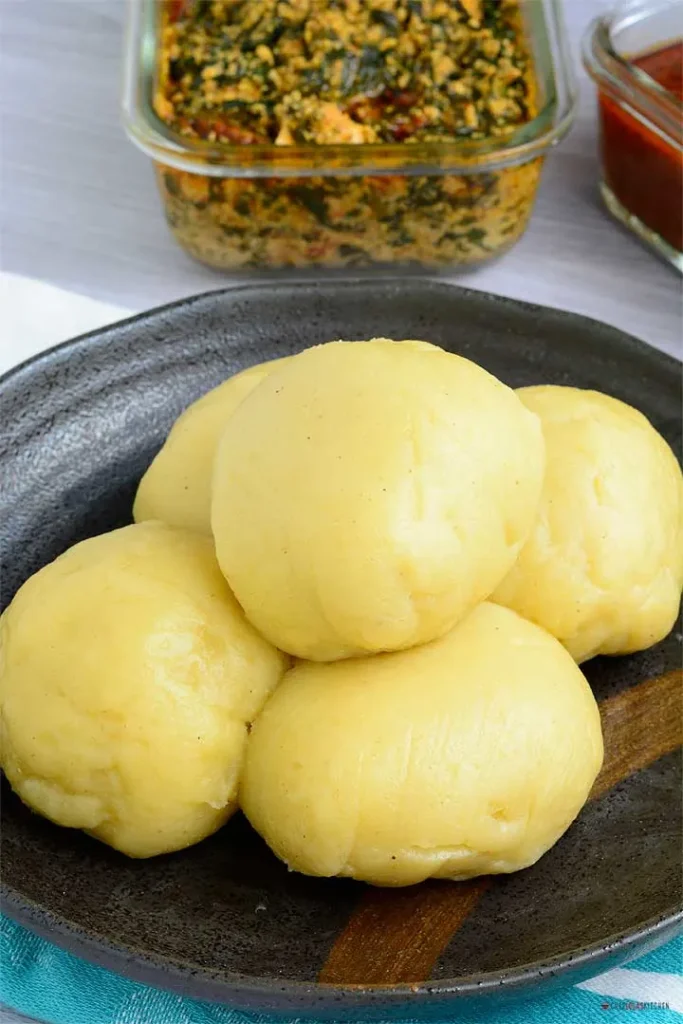
Fufu Recipe – (Foofoo)
Fufu is easy to make, yet so delicious. It is not eaten alone; it is served with a rich, flavorful soup or stew such as okra soup, ewedu soup (Jute leaves), efo riro, or light soup.
On this blog, you will find a growing collection of West African recipes that deserve just as much attention as anything else on the site. My Egusi Soup and Okra Soup are two of the most popular, and both pair beautifully with this fufu.
WHAT EXACTLY IS FUFU?
Fufu, also spelled Foofoo or Foufou, is made from cassava, which is also known as yuca. It is a starchy root vegetable, similar to sweet potatoes, russet potatoes, and yams. It can be fried, baked, and prepared just like potatoes; however, it becomes very smooth, doughy, and elastic when made into fufu.
Though traditionally made from cassava, fufu’s definition has expanded over the years to include a variety of swallow foods, such as eba, green plantains, amala, cocoyam, corn, pounded yam, semolina, and much more.
This version of the Fufu recipe uses a combination of fresh cassava and green plantain, which is my personal preference. More on why in a moment.

What Exactly Are “Swallow Foods”
If you are unfamiliar with the concept, swallow foods are a category of West African foods: pliable, smooth, doughy meals similar to America’s mashed potatoes but with a much firmer, more elastic texture.
Nigerian examples include pounded yam, eba, amala, starch, fufu, and many more. The pliable texture makes it easy to eat with your hand (right hand only, please) and to swallow without chewing.
Each of these swallow foods has its own texture and flavor profile and pairs with different soups and stews depending on personal and regional preference.
To eat fufu, cut out a morsel from the meal, then form an indentation with your thumb, scoop some stew or soup over it, and swallow!
Ingredients You Will Need
- Cassava (yuca root): The base of this fufu. Look for sweet cassava at your local African, Caribbean, or Latin grocery store. It should feel firm with no soft spots or discoloration. Peel it, remove the inner woody core, and dice it into small cubes before blending.
- Green plantain: Added to reduce stretchiness and add a subtle depth of flavor. Make sure it is green. Not yellow, not spotted. A green plantain is starchy and firm, which is exactly what you need here. A ripe or overripe plantain will make the fufu too sweet and change the texture significantly.
- Water: Just a small splash to help the batter blend smoothly and to add moisture during cooking so the fufu does not dry out or become too stiff.
How to Make Fufu
Step 1: Prep the cassava. Peel the cassava, slice it lengthwise, and remove the thin inner wooden core that runs through the center. This part does not blend and will leave fibrous bits in your batter if left in. Dice the prepared cassava into small cubes.
Step 2: Prep the plantain. Peel the green plantain and cut into small cubes. Green plantain skin can be tough to remove. Score it lengthwise with a knife first and then peel it away.
Step 3: Blend. Add both the cassava and green plantain cubes to a blender. Add a splash of water and blend until completely smooth. Take your time here. The smoother the batter, the smoother your fufu will be.
Step 4: Cook
Stovetop Method: Pour the batter into a pot and place over medium heat. Begin stirring immediately and continuously with a sturdy wooden spoon or spatula. The batter will start to thicken quickly as it heats. Keep stirring vigorously until a thick, smooth, paste-like dough forms. Add a splash of water, cover, and cook on low to medium heat for 5 minutes. Stir well again, taste, and cook a little longer if needed. The fufu should be smooth, stretchy, and pull away cleanly from the sides of the pot.
Microwave Method: Pour the batter into a microwave-safe bowl and cover with a microwave-safe lid. Microwave for 5 minutes. Remove and stir vigorously until smooth. Add a splash of water, return to the microwave, and cook for another 5 to 8 minutes until fully cooked. Stir again until completely smooth.
Step 5: Portion and wrap. Divide the fufu into individual portions and wrap each one tightly in plastic wrap. This keeps the fufu moist, prevents a dry crust, and makes it easy to serve individually. Serve immediately with your soup or stew of choice. If serving immediately, you don’t need to wrap it.

How To Eat Foufou
This is the part that surprises most people who are new to fufu. You do not chew it. You swallow it.
Pinch off a small piece, roll it into a smooth oval ball between your palms, press your thumb into the center to make a small indentation, and use that indentation to scoop up some of your soup or stew, then swallow
Yes, I said swallow – no chewing! The ”chewing instinct” might set in, but with practice, the art of swallowing fufu can be mastered!
Washing of hands before eating any swallow food is like a rite. As long as the hand-washing ritual is observed, then cutlery is not needed.
Traditionally, we Nigerians eat only with our right hand, so if you have been invited to the home of a Nigerian friend or are eating at a traditional Nigerian restaurant, please remember to eat only with your right hand, even if you are personally left-handed.
Fufu With Plantains? Do you have to add plantains?
No, you do not. Fufu made with only cassava is the traditional version, and it is wonderful on its own. But for this recipe, I add green plantain to the mix, and I’ll to tell you why.
Green plantain does two very specific things in this fufu. First, it cuts down the stretchiness of the cassava slightly, giving the fufu a smoother, more manageable texture that I personally find easier to eat and to shape.
Second, it adds a very subtle hint of plantain flavor that I love. It is mild and barely detectable, but it rounds out the taste in a way that feels complete.
If you have never cooked with green plantains before, you will also find them featured in my Plantain fufu recipe.
Green plantains and ripe plantains behave and taste completely differently, which is part of what makes plantains such a fascinating ingredient to cook with.
Cooking With Cassava Safely
I want to address this directly because it comes up often. You might have heard that raw cassava naturally contains compounds that can release cyanide. I know it sounds a little scary, but there is really no need to panic! There is important context here.
There are two varieties of cassava: bitter cassava and sweet cassava. Bitter cassava contains significantly higher levels of these compounds and requires extensive processing. Soaking, fermenting, or prolonged cooking before it is safe to eat.
Sweet cassava, which is the variety widely sold in grocery stores and markets outside of Africa, contains much lower levels that are effectively eliminated through the cooking process.
For this recipe, I use sweet cassava, and the cooking step, whether on the stovetop or in the microwave, is what takes care of any residual concern. As long as you cook the fufu properly and use sweet cassava, there is nothing to worry about.
This is food that has been safely consumed across generations and entire continents. Just make sure you buy sweet cassava and cook it fully, and you are completely fine.
What About Fermented Fufu?
Fermented fufu is a whole other experience. I’m personally not a fan; I prefer the mild, clean flavor of fresh fufu, but I know some people who love the funky, sour depth the fermentation brings.
Making fermented fufu requires just one additional step. After peeling and dicing the cassava, submerge it in water and leave it to soak and ferment for 3 to 5 days before blending and cooking. Everything else stays exactly the same.
The result will have a stronger, more pungent aroma and a tangier flavor, distinctly different from the fresh version.
What to serve with Fufu:
- Egusi soup: thick, rich, and made with ground melon seeds. This is the most classic pairing for fufu and the one I grew up eating most often.
- Stewed Spinach – a slightly lighter option that works beautifully if you want something less heavy on the side.
- Okra soup: the natural viscosity of okra makes it an ideal pairing with fufu; it coats each morsel beautifully.
- Jute leaves soup – ewedu – light, slightly slimy, and typically served with stewed meat alongside fufu.
- Ogbono soup – another naturally thick, draw soup that pairs perfectly with the texture of fufu.
Frequently Asked Questions
Does Fufu Need Salt or Any Other Seasoning?
The simple answer is no!. A lot of people have been asking me this question over and over again. Fufu doesn’t need salt or any seasoning. That is why you don’t eat fufu by itself; you need a form of soup or stew to pair with it. The soup it is served with provides all the flavor.
This is a question I get asked constantly, so I want to be very clear: do not add salt or spices to fufu. Let the soup do the work.
Can I use frozen or powdered cassava?
Yes. Frozen cassava works well. Thaw it completely before blending. Powdered cassava (sold as fufu flour) is the quickest option and simply requires mixing with hot water and stirring over heat until smooth. The texture and flavor will be slightly different from fresh cassava, but both are convenient and widely used alternatives.
How To Serve Foufou
Fufu is usually served in relatively small balls and wrapped in plastic wraps to retain its moisture. It is often paired with delicious soups and stews like Egusi, Ogbono, Vegetable Soup, peanut soup, and Okro soup, depending on personal preference.
Why Does Fufu Smell?
Foofoo will only have a deep fermented smell if the cassava is left to ferment before making it into fufu. Otherwise, you will get a very mild smell, like mashed potatoes without the butter :).
Can Fufu Be reheated?
Yes, you can reheat fufu in a microwave. Simply unwrap any leftover balls and put them in a microwave-safe bowl. Just as you would with rice, add a splash of water, then microwave till heated through—about 5 minutes. Use a wooden stirrer to stir until it becomes nice and smooth.
Is Fufu Healthy?
Foufou provides a significant amount of carbs, some fats, and a bit of protein. It also provides fiber, vitamins, and minerals like:
- Choline: Nerve and brain function
- Potassium: Heart, kidney, and muscle function
- Beta carotene: Antioxidant
What Does Fufu Taste Like?
It’s hard to describe. Fufu on its own has a very mild, almost neutral flavor somewhere between potatoes and sweet potatoes with a slightly starchy, earthy undertone.
It is not meant to be eaten alone, and it is not meant to be the flavor star of the meal. Its role is to be the perfect vehicle for whatever soup or stew it is paired with, and it does that job beautifully.
Notes
- Fufu hardens as it cools. If you are not eating it immediately, cook it slightly softer than you think it needs to be; it will firm up as it sits.
- Wrap each portion individually in plastic wrap immediately after cooking to retain moisture and prevent a dry crust from forming on the surface. Skip the wrapping if you are eating immediately.
- Remove the inner wooden core of the cassava before blending. It does not soften during cooking and will leave fibrous, stringy bits in your fufu if left in.
- Use sweet cassava, not bitter cassava. Sweet cassava is widely available at African, Caribbean, and Latin grocery stores and is completely safe to cook with and eat.
- For a plantain-free version, simply leave out the green plantain and follow the same method using only cassava. The result is stretchier and slightly more elastic but equally delicious.
Other African Swallow foods that you might also enjoy:
Not sure what to serve with fufu? Browse these Delicious Soups And Stews That Goes With Fufu.

Fufu
Ingredients
- 1 Yuca root cassava
- 1 plantain Green
- ¼ cup water
Instructions
INSTRUCTIONS FOR THE BATTER
- Peel the cassava, slice the tuber half lengthwise, remove the inner wooden core, and dice the potatoes into small cubes.
- Peel the plantain and cut it into small cubes
- Add both to a blender with the water and blend until a completely smooth batter forms.
Stovetop method
- Pour the batter into a pot, place it on the stovetop over medium heat, and stir continuously until a thick, smooth, paste-like doughy fufu forms.
- Add a splash of water, cover, and leave to cook for 5 minutes on low to medium heat. Feel free to cook a little longer if you feel the fufu is not yet cooked. Continue stirring until it reaches a soft consistency, and it changes color to pale/cream.
- Divide the fufu into individual sizes and wrap each with plastic wrap.
- Serve with your desired soup or stew.
Microwave method
- Pour the batter into a microwave-safe bowl, cover with a microwave-safe lid. Microwave for 5 minutes. Stir well until smooth
- Add a splash of water and return to the microwave to cook till fully done. About 5 to 8 minutes.
- Stir again, divide into individual sizes and wrap each with plastic wrap if desired.
- Serve with your desired soup or stew.
Notes
Nutrition
Let’s connect on YouTube, Facebook, and Instagram. I love keeping in touch with you, and nothing brings me more joy than seeing pictures of your creations. Tag me @cheflolaskitchen on Instagram and Facebook.













What can i use cos Im in the UK 🇬🇧
Hi Mr questionable, You can use cassava flour, or plantain fufu flour, they’re all great substitutes.
Most African or Caribbean stores carry them, and you can also find them online.
I love everything because it is so easy to prepare and less time consuming, it looks delicious
Thank you ntshediseng🥰, I’m so glad you love it
I’ve seen recipes saying to use yellow plantains instead of green…which is better?
The best plaintain mix is green plantain. Yellow plantain is too ripe for making fufu.
i love fulu i want it anigan
How long will fufu last in the refrigerator? Going to try and make ahead!
If you make fufu, you can store it in the fridge for up to 5 days.
What happens if I’m left-handed? Or if I use my left hand for eating?
Hala, this is an interesting question. It is assumed that you use your left hand for everything you would normally use your right hand for. Culturally, some people don’t like it but if this assumption is right, there nothing wrong with being left handed and using it to eat.
Thank you for the recipe. Can you make this without the plastic wrap?
Of course, you can choose to serve it directly in your plate instead of using the plastic wrap.
West Africans eat fufu hundreds of years without terms fufu isn’t called a swallow is a recent socialmedia word invented by your country its rude.
best food ever maybe just cook more!
fufu is so good and it smells like my home in africa. i really miss the smell of my home in africa so i cook fufu to remind.
This is great, Mafa
I’m curious if banana will work in place of plantain? I made an online order for the ingredients, but the shopper brought me bananas instead. Can I make this with only the cassava?
No AJ, a banana will not provide the same texture and flavor as a plantain in this recipe.
Hi, i did not see where the cassava was boiled. Is it ok to eat it without boiling? We cooked it on stovetop and were concerned about the cyanide. Thanks.
I actually didn’t boil it, but rather, I blended it thoroughly before proceeding to cook. I continued the cooking process until there were no white raw streaks visible, and the consistency of the fufu became stretchy.
@Lola Osinkolu, thank you for explaining the cooking process, but I don’t see how this eliminates the cyanide, as you aren’t boiling (normally discard the water to remove the cyanide) the cassava. I grow quite a bit and eager to try this recipe.
Hi Amanda, I use sweet cassava, and the cooking step, whether on the stovetop or in the microwave, is what takes care of any residual concern. As long as you cook the fufu properly and use sweet cassava, there is nothing to worry about. I have added a section, “Cooking With Cassava,” to the post to cover that in more detail. I hope that helps.
Thanks for the clear instructions.
I am going to try this, but before I master the more complicated dishes it should accompany, I am curious you have experience with less traditional Foufou, that add butter or salt or something to have it be the main player instead of the sidekick.
I thought about experimenting and comparing with the original, and would appreciate any suggestions/advice.
Beautiful Recipe! Thank you for the video Lola 🥰
I would love to try this. But i know I’m going to be tempted to chew!
Please chew, Manisha!! 🙂
@Lola Osinkolu,i relly whant to try fufu
You will enjoy it.
Hi there,I never had fufu before,want to make it for the first time, other then the plantains, What do you add to give the fufu its yellow color?
Hello what is the thing that you put on after the egusi? Is it just curry or something else?
It’s the Nigerian stew. The recipe is here: https://cheflolaskitchen.com/african-stew/
Well it is every good recipe I am using it for a project in school it is about African
Hah! Fine. Food processor = genius. Thank you.
Old way: wash peel dice soak, soak, soak, wait, soak… pound pound pound pound pound… cheesecloth and squeeze squeeze squeeze squeeze… then cook. Fufu! lol
New way: wash peel dice — food processor — cook — Fufu! Shortened by days and steps and a lot of bicep building. Yes!
Isn’t it interesting? 😂🤣 We are signed up for a stress-free life. So good, Uhmorphous.
Hey!
What is the red sauce on top of your egusi soup in that picture? And is there a recipe for that?
Best, Mims
Mims, that is Nigerian Pepper Sauce (ata din din). You can find details about it here
Hi there! I can only find cassava flour in my town, do you know if I can make this using the flour instead of the whole vegetable?
Yes. You can get fufu powder at the grocery.
It is not a must we eat with right hand so if you can update that, it will be nice. Don’t make it look too difficult for left handed people.
My sincere apologies Nnenna 🙂
When you ferment, do you cut it into small pieces first or leave it in large chunks before putting in the water?
I cut into small chunks.
@donna, cut into small pieces.
If you wanted to make fermented fufu with plantain, would you soak the plantain too?
No, Chuck, you don’t need to ferment the plantain.
Hey everyone—Scroll way down until you see a “recipe card” and this gives the full instructions about cooking over medium low heat. (This is the recipe where she uses both plantains and cassava.) Lola, I’m so grateful for this recipe! Thank you 🙂
The instructions were very limited. Not sure if there is only one ingredient, and what degree of heat to put your stove top on. Do we add oil, butter, nothing?? Confused
The recipe is complete Dee. You only need cassava and water. No oil, no butter. Also, the recipe has been adjusted to reflect the heat level of the stove. I hope that helps?
@Dee, scroll down until you see a “recipe card.” This gives full instructions. There’s also a helpful YouTube video at the end of the post!
Do i put the batter in a dry low medium heat pot or do i add a bit of oil or butter?
Apologies for the late response, I somehow did not see this question up until now. You don’t need oil or butter not even salt. 😊
hey there’s an editor’s note in your post (the part about washing hands before eating fufu)
Hello, thanks for the info. I am not very familiar with yuca so can you explain to me what this means?
“slide the tuber in half lengthwise and remove the inner wooden core” is tuber meaning the yuca?
Hello Maria, yes, yuca is a root tuber. When I say tuber, I mean Yuca.
@Maria F, I think she meant “slice”
This might be a dumb question, but is the fufu cooked over heat or just stirred cold in a pot? If heated, what level of heat should I turn my burner to?
Hi Erica, it is not a dumb question. You need to stir it over low to medium heat. I hope that helps?
@Lola Osinkolu, yes it is man WE KNOWWWWWWWWWWWWWWWWWWWWWWW WELL I
@Lola Osinkolu, hi I was wondering did/do you have the recipe for the dough to eat with the fufu
bro its lit right there